

When Binoculars Aren't Enough: Spotting Scopes for Long-Distance Viewing in Australia

Binoculars are brilliant for getting a closer look at the world around you. For wildlife, birdwatching, sightseeing, coastal viewing and general outdoor use, a good pair of 8x or 10x binoculars will often be all you need.
But sometimes the thing you want to see is simply too far away.
Perhaps you're looking across a large wetland, trying to identify wildlife on the other side of a valley, watching something well offshore or wanting a much closer look at a distant feature in the landscape.
That's where a spotting scope starts to make sense.
So, when are binoculars no longer enough, and what does a spotting scope actually give you?
The biggest difference is magnification
Most general-purpose binoculars offer somewhere around 8x or 10x magnification.
That means an object appears approximately eight or ten times closer than it would with the naked eye.
It's a very useful level of magnification because you can still comfortably hold the binoculars in your hands, find what you're looking for relatively quickly and follow moving subjects.
Spotting scopes take things considerably further.
A typical spotting scope might offer a zoom range such as 15-45x or 20-60x. At the upper end, that's a completely different level of long-distance observation.
It can allow you to pick out details that simply aren't visible through ordinary binoculars.
When does that extra reach become useful?
Australia gives you plenty of opportunities to look a very long way.
If you're observing birds across a wetland, wildlife in open country or something along a distant ridgeline, binoculars may show you that something is there while a spotting scope can help you get a much closer look.
The same applies around the coast. Binoculars are excellent for scanning the water and quickly finding boats, birds or marine life, but a spotting scope can be useful when you want to concentrate on something much farther offshore.
Spotting scopes can also be useful for viewing across large rural properties, observing distant landscapes and at the target range.
The common factor is that you're generally looking at something a reasonable distance away and want more detail than handheld binoculars can provide.
Binoculars and spotting scopes actually work well together
It doesn't necessarily have to be a choice between one or the other.
In many situations, binoculars and spotting scopes complement each other extremely well.
Binoculars give you a wide, comfortable view and make it easier to scan a large area. Once you've found something interesting, you can move to the spotting scope for a closer look.
Trying to search a huge landscape through a spotting scope at high magnification can actually be quite frustrating because you're seeing such a small portion of the scene.
So rather than thinking of a spotting scope as a bigger, more powerful replacement for binoculars, it's often better to think of the two as doing different jobs.
More magnification isn't always better
It's very easy to compare spotting scopes by looking at the biggest magnification number.
If one goes to 45x and another goes to 60x, surely 60x must be better?
Not necessarily.
As magnification increases, your field of view becomes narrower and any movement becomes much more noticeable. Available light, optical quality and atmospheric conditions also become increasingly important.
There's little benefit in making something appear larger if the resulting image doesn't allow you to see any additional useful detail.
Sometimes a clear image at 30x or 40x will show you more than a poor image at 60x.
Australian heat can make a big difference
This is particularly relevant in Australia.
On a warm or hot day, you've probably seen the air appearing to shimmer above a road or across an open landscape.
You're seeing atmospheric distortion caused by layers of air at different temperatures.
A spotting scope magnifies that too.
Over long distances, particularly across sun-heated ground, increasing the magnification can sometimes make the shimmering more obvious rather than giving you a clearer view of your subject.
That doesn't mean there's anything wrong with the scope.
It simply means the atmosphere between you and whatever you're viewing has become the limiting factor.
On those days, backing the magnification down can actually produce a more useful image.
You'll usually want a tripod
One of the biggest practical differences between binoculars and spotting scopes is how you use them.
Binoculars are designed primarily for handheld viewing. Spotting scopes, particularly at higher magnifications, are normally used on a tripod or another suitably stable support.
At 10x, a small amount of movement is noticeable.
At 40x or 60x, it's considerably more noticeable.
A stable tripod lets the spotting scope actually deliver the detail its optics are capable of producing. It also makes longer periods of observation far more comfortable.
If you're choosing a spotting scope, it's worth thinking about the support underneath it as part of the complete setup rather than as an afterthought.
What about straight and angled spotting scopes?
You'll also come across both straight and angled spotting scopes.
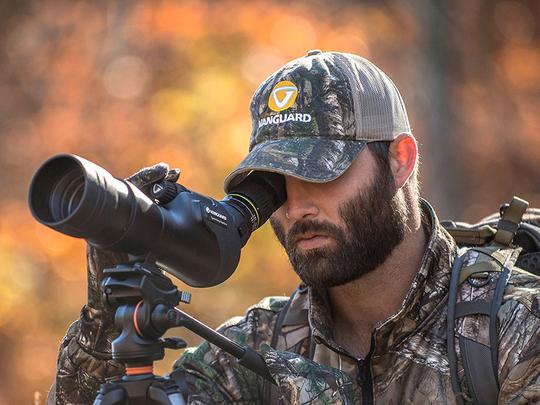
With a straight spotting scope, you look directly through the body of the scope towards the subject. Some people find this particularly intuitive when locating and following something at a distance.
With an angled spotting scope, the eyepiece sits at an angle to the body. This can be very comfortable for longer viewing sessions and can make it easier for people of different heights to share the same scope without constantly changing the tripod height.
Neither design is automatically better.
The right choice comes down largely to how and where you expect to use it.
Do you actually need a spotting scope?
If most of your viewing is relatively close and you value being able to quickly scan an area, follow moving subjects or carry your optics around all day, binoculars may still be the better choice.
But if you regularly find yourself looking through your binoculars and wishing you could get significantly closer, that's a pretty good indication that a spotting scope could be useful.
They're particularly good when you're staying in one place for a while and want to explore distant subjects in much greater detail.
And you don't necessarily need 60x every time you use one.
A good spotting scope gives you the flexibility to choose the magnification that works best for the subject, distance, light and atmospheric conditions at the time.
Choosing a spotting scope in Australia
If you're looking at spotting scopes, don't base the decision purely on which model has the biggest magnification number.
Think about where you'll use it, how far you'll need to carry it, whether you prefer a straight or angled body, the size and weight of the scope, optical quality and the tripod you'll be using with it.
Most importantly, think about what you're actually trying to see.
If you're not sure whether binoculars or a spotting scope would suit what you're doing, get in touch and we'll be happy to help. Tell us where and how you plan to use it and we can help you work through the options.